
aws kms · pricing · aws
AWS KMS Pricing: The Key Is $1, the Requests Are the Bill
By Aakash Verma ·
How much does AWS KMS cost? A customer managed key is $1 a month, prorated by the hour. Symmetric requests (Encrypt, Decrypt, GenerateDataKey) are $0.03 per 10,000, after 20,000 free a month. Asymmetric requests are $0.15 per 10,000, except RSA 2048 keys at $0.03, and GenerateDataKeyPair with RSA pairs is $12 per 10,000. Those are the US East prices on the AWS KMS pricing page and in the AWS Price List file published November 25, 2026, which we checked on November 26.
Almost nobody gets a big KMS bill from keys. They get it from requests that something else makes on their behalf, and the usual something is S3.
The key line, and rotation
Every customer managed key costs $1 a month: symmetric, asymmetric, HMAC, imported key material, keys in a CloudHSM or external key store, all the same. Multi-Region keys bill the primary and each replica separately, so one key in three Regions is $3.
Rotation adds a version, and versions cost money, but only the first two. A key rotated once costs $2 a month, twice or more $3, and it stops there. So the worst case for a key you rotate every year is $3 a month forever. AWS managed keys (the aws/s3, aws/ebs kind) have no monthly fee at all. Keys scheduled for deletion are free while they wait, and if you cancel the deletion it bills as though you never scheduled it.
Twelve keys, all rotated a few times: $36 a month. That’s the number people look at in the console and decide KMS is cheap. It is, until the request line shows up.
Where requests come from
| Request | Price per 10,000 (US East) | In the free 20,000? |
|---|---|---|
| Symmetric (Encrypt, Decrypt, GenerateDataKey, …) | $0.03 | Yes |
| Asymmetric with RSA 2048 keys | $0.03 | No |
| Other asymmetric (ECC, RSA 3072/4096, ML-DSA: Sign, Verify, Encrypt, Decrypt) | $0.15 | No |
| GenerateDataKeyPair, ECC pairs | $0.10 | No |
| GenerateDataKeyPair, RSA pairs | $12.00 | No |
The free 20,000 are counted across every Region in the account, and only symmetric requests use them.
Your own code calling KMS directly is rarely the problem. The volume comes from services that call it for you: S3 with SSE-KMS, Secrets Manager when secrets use your key (we covered that one in the Secrets Manager pricing post), DynamoDB, SQS, Lambda environment variables. Those calls are billed under Key Management Service, not under the service that made them. Filter Cost Explorer to S3 and the cost of encrypting S3 isn’t there.
A worked example
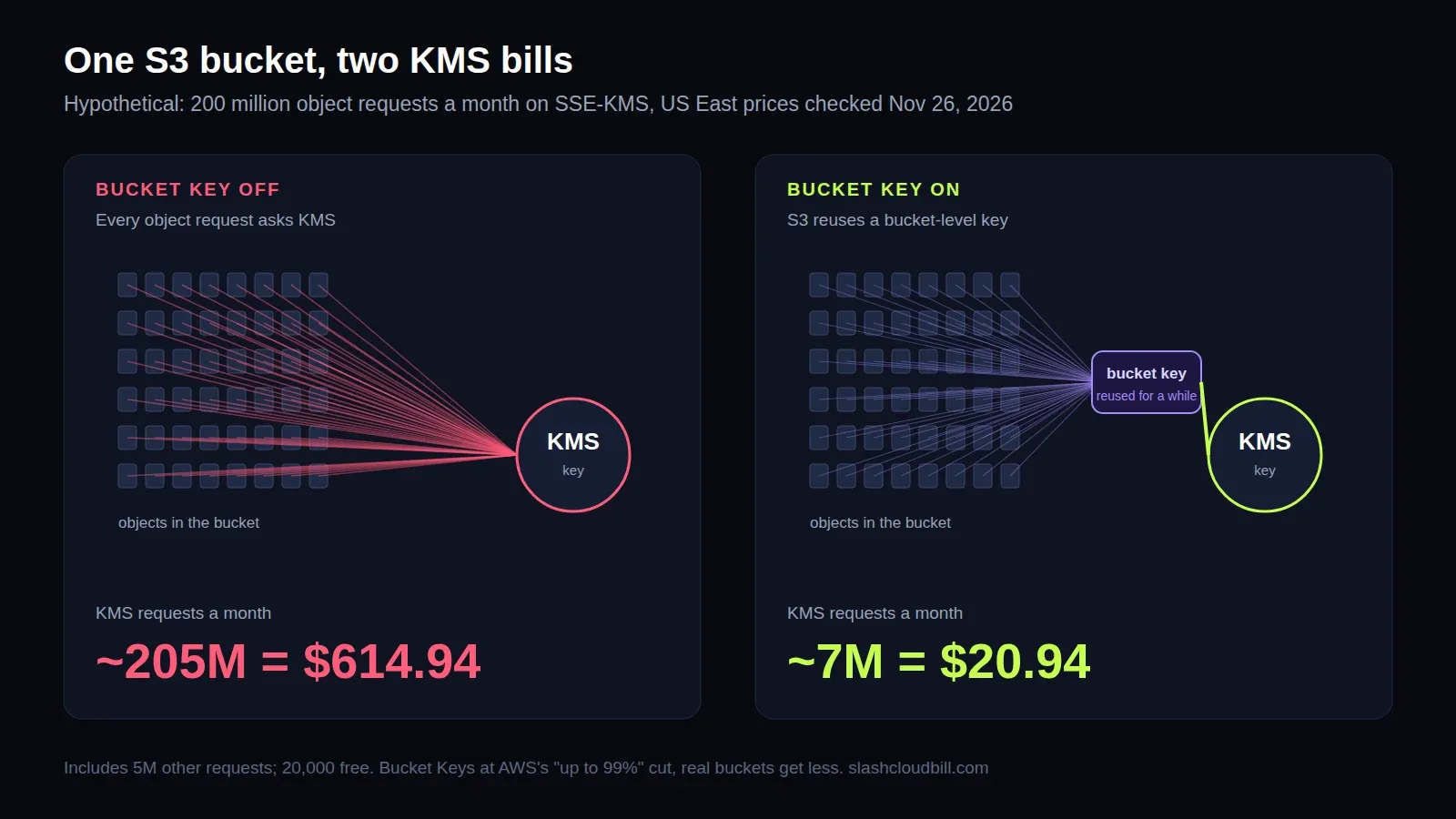
Hypothetical, US East: twelve customer managed keys rotated yearly for three years, an image bucket with SSE-KMS serving 200 million object requests a month (uploads, thumbnails, reads), 5 million other symmetric requests from the app, and 100,000 ECC signatures for webhook payloads.
- Keys: 12 x 3 billed versions x $1 = $36.00
- Symmetric: 205,000,000 minus 20,000 free = 204,980,000 requests at $0.03 per 10,000 = $614.94
- ECC signing: 100,000 at $0.15 per 10,000 = $1.50
Total $652.44 a month. Ninety-four percent of it is the bucket.
Turn on S3 Bucket Keys for that bucket and S3 asks KMS for a bucket-level key, reuses it for a while, and makes far fewer calls. AWS’s Bucket Keys documentation says it can cut S3’s request traffic to KMS by up to 99%. At the full 99%, the bucket drops to about 2 million requests and the whole bill to $58.44. Real buckets don’t always get the full 99%, so treat that as the floor. Even at 90% the bill is under $100.
Two things to know before you flip it. A Bucket Key applies to new objects, so old objects keep calling KMS until they’re copied or rewritten. And CloudTrail logs show the bucket ARN as the encryption context instead of the object ARN, which matters if someone built alerts on the old format.
The RSA key pair trap
GenerateDataKeyPair with an RSA pair costs $12 per 10,000. That’s 400 times a symmetric request. One million a month is $1,200. We’ve seen designs that generate a fresh RSA pair per user session or per message “for security”. If you need a new key per thing, a symmetric data key from GenerateDataKey costs $0.03 per 10,000, and an ECC pair is $0.10. Use RSA pairs only where a protocol actually needs RSA.
What to check on your own bill
- In Cost Explorer, filter Service to Key Management Service and group by usage type.
KMS-RequestsagainstKMS-Keystells you which half you have. - If it’s requests, look at CloudTrail for
DecryptandGenerateDataKeyevents and group by the calling service. S3 is the usual answer. - Check
aws s3api get-bucket-encryptionon the busy buckets for"BucketKeyEnabled": true. - Search the code for
GenerateDataKeyPair.
Our AWS KMS pricing calculator does the arithmetic with your numbers, rotations and Bucket Keys included. You can also price it in the AWS Pricing Calculator, though it won’t tell you which service made the requests.
KMS is rarely the biggest line on an AWS bill, but it’s one of the easiest to cut, and it tends to sit next to bigger ones. Our free cloud cost audit reads the whole bill for $0. If you’d rather we fix it, we reduce startup AWS bills for $0 up front: you pay 50% of the verified monthly saving for 6 months, then nothing, and nothing at all if nothing is saved.
Want us to look at your bill?
No upfront fee: for six months you pay half of what we save you each month, then you keep all of it. Nothing saved, nothing owed.
Also here: Free cloud cost audit ($0) · Cloud cost optimization services: $0 up front · Reduce your startup's AWS bill · FinOps for startups: $0 audit · Pricing: paid only from verified savings · Move from AWS to a European cloud