
aws ses · pricing · email
AWS SES Pricing: New Accounts Pay $0.16, Not $0.10
By Aakash Verma ·
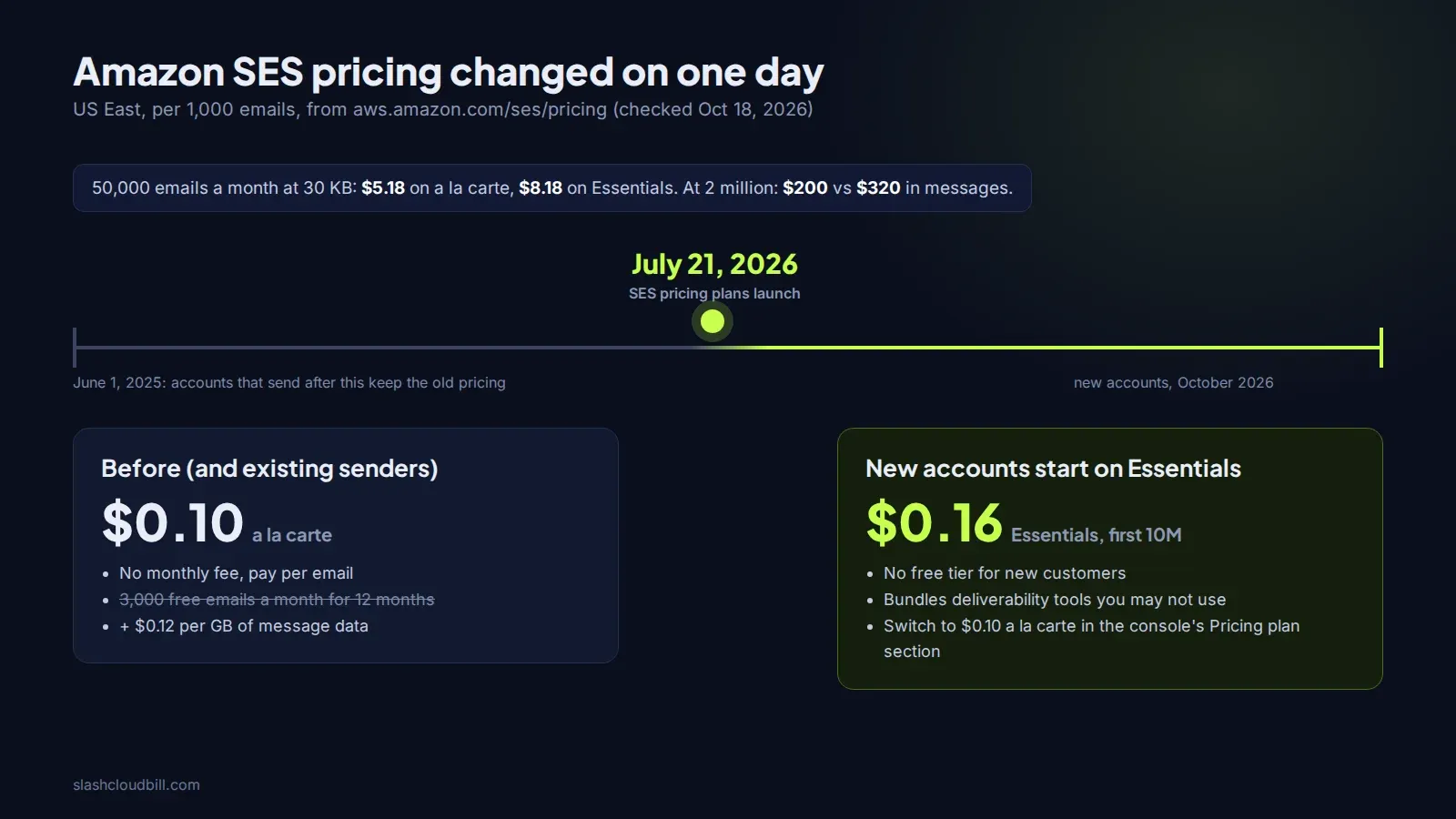
Most of what you’ll read about Amazon SES pricing says the same thing: ten cents per thousand emails, the cheapest transactional email you can buy, and free for your first 3,000 a month. Two of those three stopped being true for new accounts on July 21, 2026.
That day AWS put SES into plans. If you open a new AWS account now, or switch on SES in an account that hasn’t sent anything through it since June 1, 2025, you start on a plan called Essentials. Essentials charges $0.16 per thousand emails. The old ten-cent price still exists, now called “a la carte”, but you have to choose it. And the SES free tier of 3,000 messages a month for the first year is gone for new customers. The source for all of this is AWS’s own SES pricing page and its announcement of the plans, both checked on October 18, 2026, and the AWS Price List API for US East.
The four ways to pay
Per thousand emails, for the first 10 million a month:
- A la carte: $0.10, no monthly fee. What existing senders stay on.
- Essentials: $0.16, no monthly fee, then $0.14 above 10 million and $0.11 above 100 million. Includes Virtual Deliverability Manager for SES and some Mail Manager features.
- Pro: $105 a month plus $0.22, with one managed dedicated IP, one monitored domain and five inbox placement tests included.
- Enterprise: $500 a month plus $0.23, with 5 domains, 12 managed dedicated IPs and 25 placement tests.
On top of any of them you pay for the size of what you send: $0.12 per GB of outgoing message data, attachments included. Receiving mail is $0.10 per thousand plus $0.09 per thousand 256 KB chunks. A standard dedicated IP is $24.95 a month.
AWS says the plans cost “up to 22% less” than buying the same features one by one. That’s true if you’d buy them. The catch is the default: a small SaaS that sends password resets, receipts and a weekly digest gets put on Essentials and pays 60% more per message for deliverability dashboards nobody on the team opens.
What that looks like on a real-sized bill
Take a product that sends 50,000 emails a month at about 30 KB each, which is a typical HTML receipt with a logo. That’s 1.5 GB of message data, so $0.18 whatever the plan.
On Essentials the messages cost 50,000 x $0.16 / 1,000 = $8.00, so $8.18 a month. On a la carte it’s $5.00 + $0.18 = $5.18. Three dollars. Nobody will notice three dollars, and if that’s your volume you can stop reading here.
The difference scales, though. At 2 million emails a month (a marketplace with notifications on, or a B2B tool sending daily reports) Essentials is $320 in messages and a la carte is $200. At that point you’re paying $1,440 a year for the default, and it’s worth ten minutes to find out whether you use anything Essentials gives you.
Then there’s message size, which is the line I’d look at first on most SES bills. Every byte counts. Attach a 2 MB PDF invoice to every order confirmation and each thousand emails carries 2 GB of data, $0.24, which is more than the message price itself on a la carte. Link to the PDF instead of attaching it. Shrink the logo that’s embedded as a 400 KB PNG. Those changes cost nothing and work on every plan.
How to tell which one you’re on
In the SES console, the Pricing plan section shows the current plan for the account and region, and it’s also where you switch. Plans are per account per region, so an account that sends from us-east-1 and eu-west-1 can be on different ones. If you set up a second region recently, check it separately.
Your bill shows it too. In Cost Explorer, filter the service to SES and group by usage type: a la carte message charges show as Recipients, plan charges as Essentials-Outbound-Email or the Pro or Enterprise equivalent, and the plan fee as its own line. The SES developer guide covers the console side if you haven’t touched SES settings in a while.
Is SES still the cheap option?
Yes. Even on Essentials, SES is far below the email APIs most startups use. Resend’s pricing page puts 50,000 emails a month on its $20 Pro plan, and 2 million on its $825 Scale plan plus overage, about $1,085 a month. SES at either volume is a rounding error by comparison. You pay for that with more setup: domain verification, getting out of the sandbox, handling bounces and complaints yourself through SNS or EventBridge.
What changed is that “SES costs ten cents” now needs a footnote, and the free first year that made it free for side projects is gone. If your app sends email through SES, put your own numbers into our Amazon SES pricing calculator; it shows the same month on all four options side by side.
Want us to look at your bill?
No upfront fee: for six months you pay half of what we save you each month, then you keep all of it. Nothing saved, nothing owed.
Also here: Free cloud cost audit ($0) · Cloud cost optimization services: $0 up front · Reduce your startup's AWS bill · FinOps for startups: $0 audit · Pricing: paid only from verified savings · Move from AWS to a European cloud