
elasticache · aws · pricing
ElastiCache Pricing: Old Redis Versions Now Cost 80% More
By Aakash Verma ·
How much does Amazon ElastiCache cost? On a node-based cluster you pay per node per hour: a cache.t4g.micro is $0.0128 an hour on Valkey and $0.016 on Redis OSS, a cache.r7g.large $0.1752 and $0.219, in US East (N. Virginia). ElastiCache Serverless bills $0.084 per GB-hour of data stored plus $0.0023 per million ECPUs on Valkey, and $0.125 and $0.0034 on Redis OSS. Those are from the ElastiCache pricing page and the AWS Price List (published November 25, 2026), checked November 27, 2026.
Those are the prices people look up. The line that has been quietly growing bills this year is a different one.
The Extended Support line
Redis OSS 5 reached end of standard support on ElastiCache on January 31, 2026. Clusters that stayed on it (and on 4) didn’t stop working. They moved to Extended Support, which AWS prices as a premium on the On-Demand node price: 80% on top in years one and two (February 1, 2026 to January 31, 2028) and 160% in year three, to January 31, 2029.
In the price list that’s a separate usage type per node, ExtendedSupportYr1_Yr2-NodeUsage. For a cache.r7g.large it’s $0.175 an hour next to the $0.219 node, and $0.35 in year three. Cost Explorer shows it as its own usage type, so filter on it once; if anything comes back, you have a version problem, not a sizing problem.
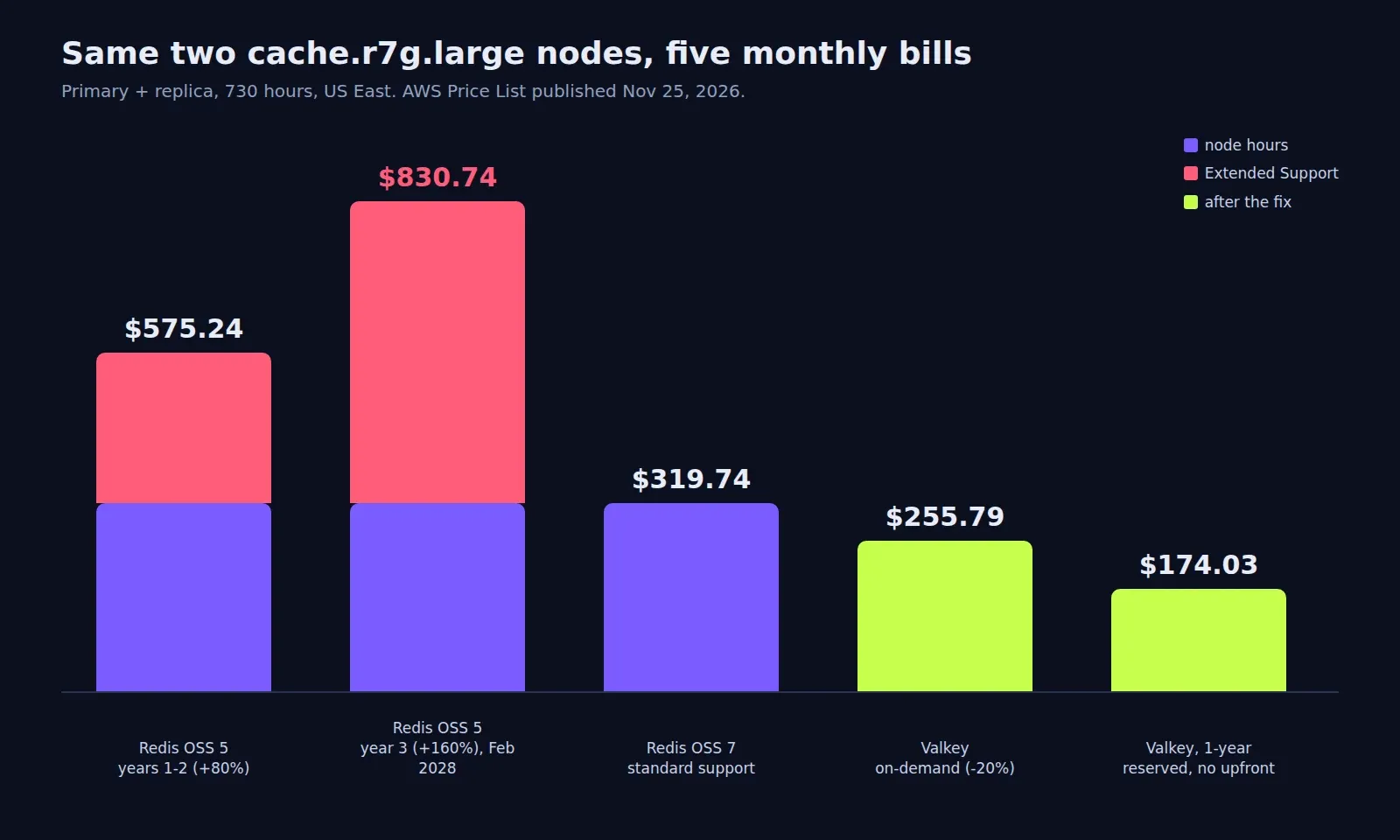
Here’s a hypothetical cluster, a primary and one replica on cache.r7g.large, 730 hours a month:
| Setup | Node line | Extended Support | Month |
|---|---|---|---|
| Redis OSS 5, years 1 and 2 | $319.74 | $255.50 | $575.24 |
| Redis OSS 5, year 3 (from Feb 2028) | $319.74 | $511.00 | $830.74 |
| Redis OSS 7, standard support | $319.74 | $0 | $319.74 |
| Valkey, same nodes | $255.79 | $0 | $255.79 |
| Valkey, 1-year reserved, no upfront | $174.03 | $0 | $174.03 |
From $575.24 to $174.03 is the same two nodes doing the same job. Nothing about the application changed. The reserved price is $0.1192 an hour per node from the price list; reserved nodes are size flexible, and AWS quotes up to 55% off for all upfront.
The order matters. Reserve after you upgrade, not before: a reservation is for an engine family and node type, and buying one for a Redis OSS 5 cluster you are about to move locks in the wrong thing. AWS lets ElastiCache upgrade a cluster to Valkey in place, and clients keep talking to it with the same commands. Test the upgrade on a snapshot restored into a staging cluster first. It’s the boring way, and it’s the one that doesn’t page anyone.
Nodes: you pay for the box, full or empty
A node costs the same whether it holds 10 MB or 12 GB. The usual setup is a primary plus a replica, so every price is doubled from the start, and cluster mode with three shards and one replica each is six nodes. Before changing anything, look at BytesUsedForCache and EngineCPUUtilization in CloudWatch over a month. A cache.r7g.large has 13.07 GiB of memory; if it’s using 1.5 GB, a cache.t4g.medium (3.09 GiB, $0.052 an hour on Valkey) holds that with room to spare.
Valkey is 20% cheaper than Redis OSS on every node type, and has no Extended Support line because the versions ElastiCache offers are current. Memcached is priced like Redis OSS.
Serverless: read the minimum first
Serverless bills the data you store per GB-hour and the work your requests do in ECPUs. A simple read or write uses 1 ECPU per KB transferred, and heavier commands use more. There’s a floor: at least 1 GB stored per cache on Redis OSS and Memcached, which is $91.25 a month at $0.125 even if the cache holds 20 MB. Valkey’s floor is 100 MB, about $6.13.
A hypothetical cache averaging 2 GB stored and 500 million ECPUs a month comes to $123.79 on Valkey Serverless ($122.64 storage, $1.15 requests) and $184.20 on Redis OSS. In most real caches the storage line is nearly all of it, so the lever is what you put in the cache and how long it stays there (TTLs), not how often you read.
The lines around the cache
Backups cost $0.085 per GB-month. Traffic between your app and the cache is free inside one Availability Zone; across zones in the same Region your application side pays the standard EC2 data transfer rate of $0.01 per GB each way. On a busy cache with app servers spread across three zones, that line can catch up with the nodes. On Valkey 9.0, synchronous durability (writes acknowledged after they’re stored durably) adds 18% to the node price; asynchronous writes cost nothing extra.
Our ElastiCache pricing calculator now has the Extended Support line and the durability option, so you can put your own node type and count in.
If you’d rather not untangle it yourself: we do this as part of reducing AWS bills, with $0 up front, then 50% of the verified monthly saving for six months, and nothing if nothing is saved. Or start with the free cloud cost audit: send the bill lines, no logins, and a person replies by email.
Want us to look at your bill?
No upfront fee: for six months you pay half of what we save you each month, then you keep all of it. Nothing saved, nothing owed.
Also here: Free cloud cost audit ($0) · Cloud cost optimization services: $0 up front · Reduce your startup's AWS bill · FinOps for startups: $0 audit · Pricing: paid only from verified savings · Move from AWS to a European cloud