
gemini · llm · pricing
Gemini API Pricing: Two Price Increases Are Coming
By Aakash Verma ·
Gemini 3.8 Flash costs $0.75 per million input tokens and $3.75 per million output tokens, and both prices double on January 1, 2027. Gemini 4 Argon, the new flagship, is $2 and $10 until November 30 and $4 and $20 from December 1, 2026. Those dates are printed on Google’s own Gemini API pricing page (last updated October 22), which we checked on October 25.
So if your product calls Gemini, your AI bill is going up by default in about five weeks, without you shipping anything. Here’s what each model costs now, what changes, and the line on the bill most people don’t notice until it shows up.
Prices per million tokens, paid tier
Standard requests, prompts up to 200k tokens, text, image or video input:
| Model | Input | Cached input | Output | Changes |
|---|---|---|---|---|
| Gemini 4 Argon | $2.00 | $0.10 | $10.00 | Doubles on Dec 1, 2026 |
| Gemini 3.1 Pro Preview | $2.00 | $0.20 | $12.00 | Higher above 200k ($4 / $18) |
| Gemini 3.8 Flash | $0.75 | $0.075 | $3.75 | Doubles on Jan 1, 2027 |
| Gemini 3.6 Flash | $0.75 | $0.075 | $3.75 | Doubles on Jan 1, 2027 |
| Gemini 3.5 Flash-Lite | $0.30 | $0.03 | $2.50 | No change announced |
| Gemini 2.5 Flash | $0.30 | $0.03 | $2.50 | No change announced |
| Gemini 2.5 Flash-Lite | $0.10 | $0.01 | $0.40 | No change announced |
Output includes thinking tokens. That matters more than the headline price, because a model that reasons for 2,000 tokens before writing a 300-token answer bills you for 2,300 output tokens. Output costs five times the input price on Flash, so it can be the bigger half of the bill even when there are seven times fewer output tokens than input (the example below is exactly that). The thinking docs show how to cap it with a thinking budget or level, which is the cheapest fix there is: one parameter, no model change.
What the increases do to a real workload
Take a support assistant doing 5,000 requests a day. Each request sends 3,000 tokens (system prompt, a few turns of history, a snippet of docs) and gets 400 back. Half of the input repeats from call to call and is served from the cache. Over a 30-day month that’s 450 million input tokens and 60 million output tokens.
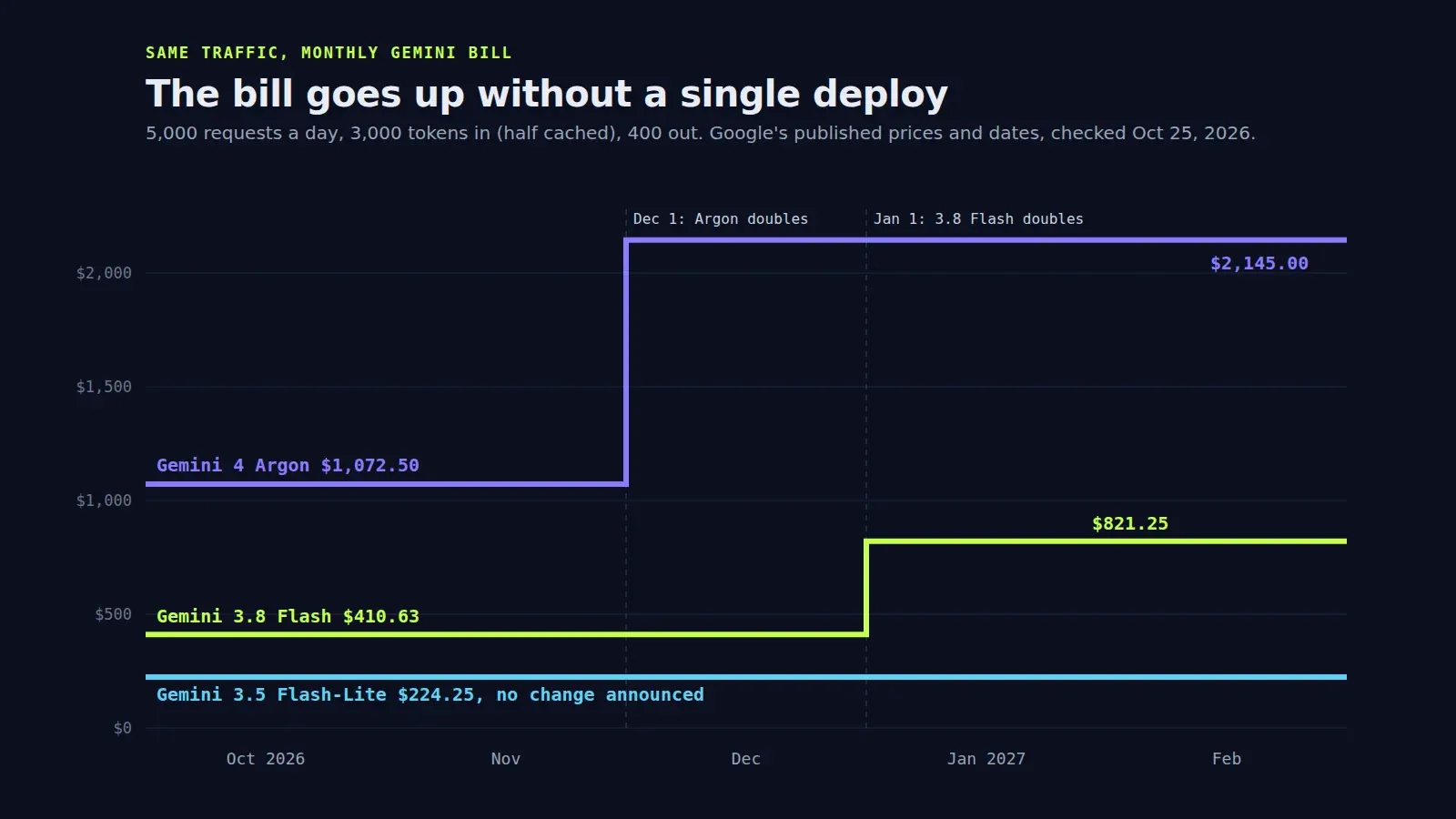
- Gemini 3.8 Flash: $410.63 a month today, $821.25 from January 1.
- Gemini 4 Argon: $1,072.50 today, $2,145.00 from December 1.
- Gemini 3.5 Flash-Lite: $224.25, before and after.
- Gemini 2.5 Flash-Lite: $48.75, if the task is simple enough for it.
The jump on Flash is the one we’d plan for. Flash is the default model in a lot of codebases because it was cheap and good enough, and teams tend to pick it once and never revisit. In January the same traffic costs as much as two months of December.
You can put your own numbers into our Gemini API pricing calculator, which has a date switch for exactly this.
The grounding line
This is the one that catches people moving to the newer models.
On Gemini 2.5 Flash and Flash-Lite, Grounding with Google Search gives you 1,500 grounded prompts a day free, then $35 per 1,000. On Gemini 3 and newer it’s billed differently: per search query the model decides to run, with 5,000 free a month shared across your whole project, then $14 per 1,000. Google’s docs say plainly that one prompt can trigger several searches.
So an app grounding 1,000 prompts a day pays $0 for search on 2.5 Flash. Move it to 3.5 Flash-Lite, which costs the same per token, and search alone is about $350 a month, more if the model searches twice per prompt. The token price comparison looks like a wash and the invoice isn’t.
Batch, Flex and Priority
Batch mode is half price on every model above, results within 24 hours. Flex is listed at the same price as Batch. Priority costs 1.8 times Standard (Flash input goes from $0.75 to $1.35). For our support example, Batch would cut 3.8 Flash from $410.63 to $205.31, but nobody waits a day for a support answer. It’s for the other jobs: nightly summaries, tagging, re-embedding, evals. Those often run on the same API key as the live feature at full price, simply because nobody split them out.
Caching
Cached input is a tenth of the normal input price on most Gemini models. Implicit caching happens on its own when prompts share a long prefix, so put the stable part (system prompt, tool definitions, reference docs) first and the user’s message last. Explicit caching, where you create the cache yourself, adds a storage fee per million tokens per hour: $0.50 on 3.8 Flash today, $1.00 from January, and $4.50 on 3.1 Pro. A big cache kept alive all day on Pro can cost more in storage than it saves. Argon has implicit caching only. The caching docs explain both.
The free tier
Flash, Flash-Lite and the 2.5 models have a free tier, and on it Google’s pricing table says your data is “used to improve our products”. On the paid tier it isn’t. For anything with customer data in the prompt, that settles it, whatever the free limits are.
What we’d do before January
Measure first: the AI Studio usage page or your own logs, split by feature, input vs output vs thinking. Then cap thinking where answers are short, move anything that can wait to Batch, fix the prompt order so implicit caching kicks in, and only then test whether 3.5 Flash-Lite does the job your 3.8 Flash calls do today, on real requests. A cheaper model that needs a retry is not cheaper. And check your grounding count before you switch generations.
If you want to see how Gemini compares with Claude and OpenAI for the same traffic, the LLM API cost calculator puts them side by side, and our Claude API pricing post covers the same levers on Anthropic’s side.
Want us to look at your bill?
No upfront fee: for six months you pay half of what we save you each month, then you keep all of it. Nothing saved, nothing owed.
Also here: Free cloud cost audit ($0) · Cloud cost optimization services: $0 up front · Reduce your startup's AWS bill · Pricing: paid only from verified savings · Move from AWS to a European cloud