
posthog · pricing · analytics
PostHog Pricing: One Init Setting Can Triple the Events Line
By Aakash Verma ·
PostHog pricing is free up to a monthly allowance on every product (1 million analytics events, 5,000 session recordings, 1 million feature flag requests, 100,000 exceptions), then pay-as-you-go per unit with prices that fall as volume grows. The first paid analytics event costs $0.00005. There’s no seat fee and no plan you have to pick, which is why PostHog bills surprise people in a different way from most SaaS tools: nothing changes on the invoice until one product crosses its free line, and then the per-unit rates do the work.
We pulled every rate below from PostHog’s pricing page and the billing API it reads from, on November 11, 2026.
The rates that matter
Each product has its own free allowance and its own price ladder. These are the first two paid bands, which is where most startups sit:
| Product | Free every month | Next band | Price per unit |
|---|---|---|---|
| Analytics events | 1M | 1M to 2M | $0.00005 |
| 2M to 15M | $0.0000343 | ||
| Identified events (on top) | 1M | 1M to 2M | +$0.000198 |
| 2M to 15M | +$0.0000697 | ||
| Session replay, web | 5,000 recordings | 5K to 15K | $0.005 |
| 15K to 50K | $0.0035 | ||
| Session replay, mobile | 2,500 recordings | 2.5K to 15K | $0.01 |
| Feature flag requests | 1M | 1M to 2M | $0.0001 |
| 2M to 10M | $0.000045 | ||
| Error tracking exceptions | 100,000 | 100K to 325K | $0.00037 |
| 325K to 10M | $0.00014 | ||
| Logs | 10 GB | 10 GB to 300 GB | $0.25 a GB |
| Surveys | 1,500 responses | 1,500 to 2,000 | $0.10 |
The bands keep going down. Analytics events drop to $0.000009 past 250 million, and replays to $0.0015 past 500,000. Logs retained past the 14-day default cost $0.05 a GB for every month you keep them, and that’s the one line a billing limit can’t cap.
On top of usage there are optional platform packages: Boost $250 a month, Teams $450, Scale $750, Enterprise $2,000. You need those for things like SSO enforcement, SAML or longer retention. Most small teams don’t, and pay-as-you-go already gives 6 projects and 2 years of event retention.
Identified events are the expensive part
PostHog charges more for an event that’s attached to a person profile. Its docs on anonymous vs identified events say anonymous events “can be up to 4x cheaper”, and in the 1M to 2M band the gap is bigger than that: $0.00005 for an anonymous event against $0.000248 for an identified one.
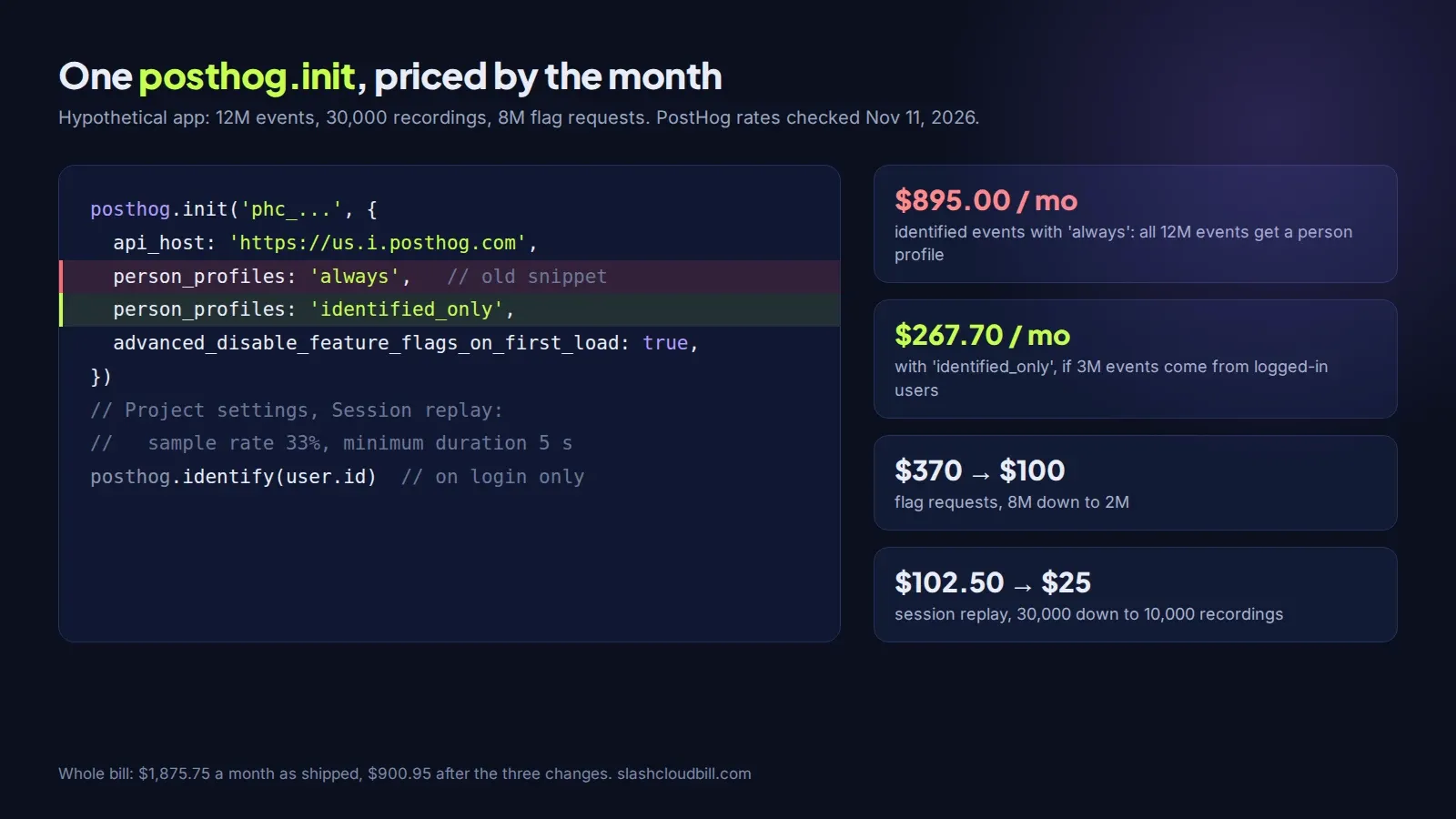
Whether an event is identified depends on one line in your posthog.init call. The default today is person_profiles: 'identified_only', which creates a profile only after you call identify() (a login, usually). A lot of apps that installed PostHog a while ago, or copied an old snippet, still have person_profiles: 'always'. That makes every event from every visitor identified, including the logged-out ones reading your landing page.
A worked bill
A hypothetical SaaS app, priced at the November 2026 rates: 12 million analytics events a month, 30,000 web session recordings, 8 million feature flag requests, 500,000 exceptions and 40 GB of logs. The init still has person_profiles: 'always', so all 12 million events are identified.
| Line | Monthly cost |
|---|---|
| Analytics events, 12M | $393.00 |
| Identified events, 12M | $895.00 |
| Session replay, 30,000 recordings | $102.50 |
| Feature flag requests, 8M | $370.00 |
| Exceptions, 500,000 | $107.75 |
| Logs, 40 GB | $7.50 |
| Total | $1,875.75 |
The identified line is almost half of it. Switch to identified_only and say 3 million of those events come from logged-in users: identified events fall to $267.70 and the bill to $1,248.45. Nothing else changed, and you still have every event; the anonymous ones just don’t get a person profile.
Session replay is the next one. Recording every session is rarely useful. PostHog lets you set a sample rate and a minimum duration per trigger group, or start recording only on certain URLs or events. Keep 10,000 recordings instead of 30,000 and the replay line goes from $102.50 to $25, the bill to $1,170.95.
Then flags. Client SDKs call /flags when they load, when a user is identified and when person properties change, so a busy marketing site with one experiment can rack up millions of requests. PostHog’s guide to cutting feature flag costs lists advanced_disable_feature_flags_on_first_load and bootstrapping for the browser, and for servers it’s worth reading the part on local evaluation: a poll with changed definitions counts as 10 requests, and an old server SDK without ETag support pays that on every poll, every 30 seconds. That’s 864,000 requests a month from one always-on server doing nothing. Get to 2 million requests and the flags line is $100, the bill $900.95.
We’d leave error tracking alone. $107.75 for half a million exceptions is fine, and if the count is that high the better fix is the bugs.
Before the invoice
PostHog lets you set a billing limit per product, and when a product hits it, ingestion stops instead of the bill growing. That’s a good default for a startup. Just know what stopping means: analytics events past the limit are dropped for good, and flags return empty with quota_limited: true, so your code falls back to defaults. Set the limit a bit above normal, not at it.
Our PostHog pricing calculator prices each product on the full ladder and shows what identified_only would change. If PostHog is one of several usage-billed tools on the card (Datadog is the usual other one, see Datadog pricing), the free cloud cost audit costs $0 and we reply by email with the lines worth cutting. Our cloud cost optimization service is $0 up front, then 50% of the verified monthly saving for 6 months, and nothing if nothing is saved.
Want us to look at your bill?
No upfront fee: for six months you pay half of what we save you each month, then you keep all of it. Nothing saved, nothing owed.
Also here: Free cloud cost audit ($0) · Cloud cost optimization services: $0 up front · Reduce your startup's AWS bill · FinOps for startups: $0 audit · Pricing: paid only from verified savings · Move from AWS to a European cloud