
route 53 · aws · pricing
Route 53 Pricing: The $0.50 Zone Is Not the Bill
By Aakash Verma ·
How much does Amazon Route 53 cost? On the Route 53 pricing page, checked November 24, 2026, a hosted zone is $0.50 a month for each of your first 25 and $0.10 after that. Standard DNS queries are $0.40 per million for the first billion a month and $0.20 per million after. Queries to alias records that point at AWS resources, like a load balancer or a CloudFront distribution, are free.
So for most startups Route 53 is a rounding error: three zones and twenty million queries is $9.50 a month. When we do see it in three figures, the zone count is never the reason. It’s one of three lines: queries that should have been free, health checks with every option switched on, or Resolver endpoints billing by the hour.
The full price list, in one place
The same numbers are in the AWS Price List API for Route 53, which AWS last published on November 18, 2026. Per million queries, first billion a month and then over a billion:
| Query type | First 1B | Over 1B |
|---|---|---|
| Standard (simple, weighted, failover) | $0.40 | $0.20 |
| Latency-based routing | $0.60 | $0.30 |
| Geolocation and geoproximity | $0.70 | $0.35 |
| IP-based routing | $0.80 | $0.40 |
The rest of the bill:
- Traffic flow: $50 a month per policy record. One policy record can cost more than everything else on a small account.
- Health checks: $0.50 a month on an AWS endpoint (the first 50 are free) or $0.75 on anything outside AWS. Each optional feature (HTTPS, string matching, fast 10-second interval, latency measurement) adds $1 on AWS endpoints and $2 outside. Checks on load balancers and S3 website endpoints are free.
- Resolver endpoints: $0.125 an hour per network interface, and each endpoint needs at least two. Forwarded queries are $0.40 per million.
- DNS Firewall: $0.60 per million inspected queries, plus $0.0005 a month per domain in your own block lists.
- Query logs and DNSSEC: Route 53 charges nothing itself, but logs land in CloudWatch and DNSSEC signing uses a KMS key, both billed on their own lines.
Private hosted zone queries are free. Hosted zones aren’t prorated: create one on the 30th and you pay the full $0.50 for that month (unless you delete it within 12 hours).
Line 1: a CNAME where an alias would be free
This is the most common one and the cheapest to fix. If app.example.com is a CNAME to my-alb-123.us-east-1.elb.amazonaws.com, every lookup is a billed standard query. If it’s an alias record to the same load balancer, the lookup is free. Same answer to the browser, different bill.
Alias works for load balancers, CloudFront, API Gateway, S3 website endpoints, Elastic Beanstalk, VPC endpoints, App Runner, AppSync, Global Accelerator and Lightsail. It also works at the zone apex, which CNAMEs can’t, so there’s rarely a reason to keep the CNAME.
For records that can’t be aliases (a SaaS custom domain, a host outside AWS), the lever is the TTL. A 60-second TTL tells every resolver to ask again every minute. Raising it to 300 seconds cuts those queries by up to five times for a record that changes once a year. Keep short TTLs only on records you actually fail over.
Line 2: health checks on outside endpoints
One basic check on a server outside AWS is $0.75. Tick HTTPS, string matching and the fast interval, and it’s $6.75 a month. Eight of those is $54. That’s not a lot, but it’s $54 for a fast interval nobody reads and latency graphs nobody opens. HTTPS on its own is usually the only feature worth paying for.
Line 3: Resolver endpoints nobody remembers
Resolver endpoints connect DNS between your VPCs and a network outside AWS: inbound so an office can resolve private VPC names, outbound so your VPC can resolve the office’s names. Two network interfaces each at $0.125 an hour makes one endpoint $182.50 a month. A typical hybrid setup has both, so $365 before the first query.
They’re often built for a VPN to an office or a data centre that later goes away. The endpoints keep billing. In Cost Explorer they sit under Route 53 with a usage type ending in ResolverNetworkInterface, which few people recognise.
A worked example
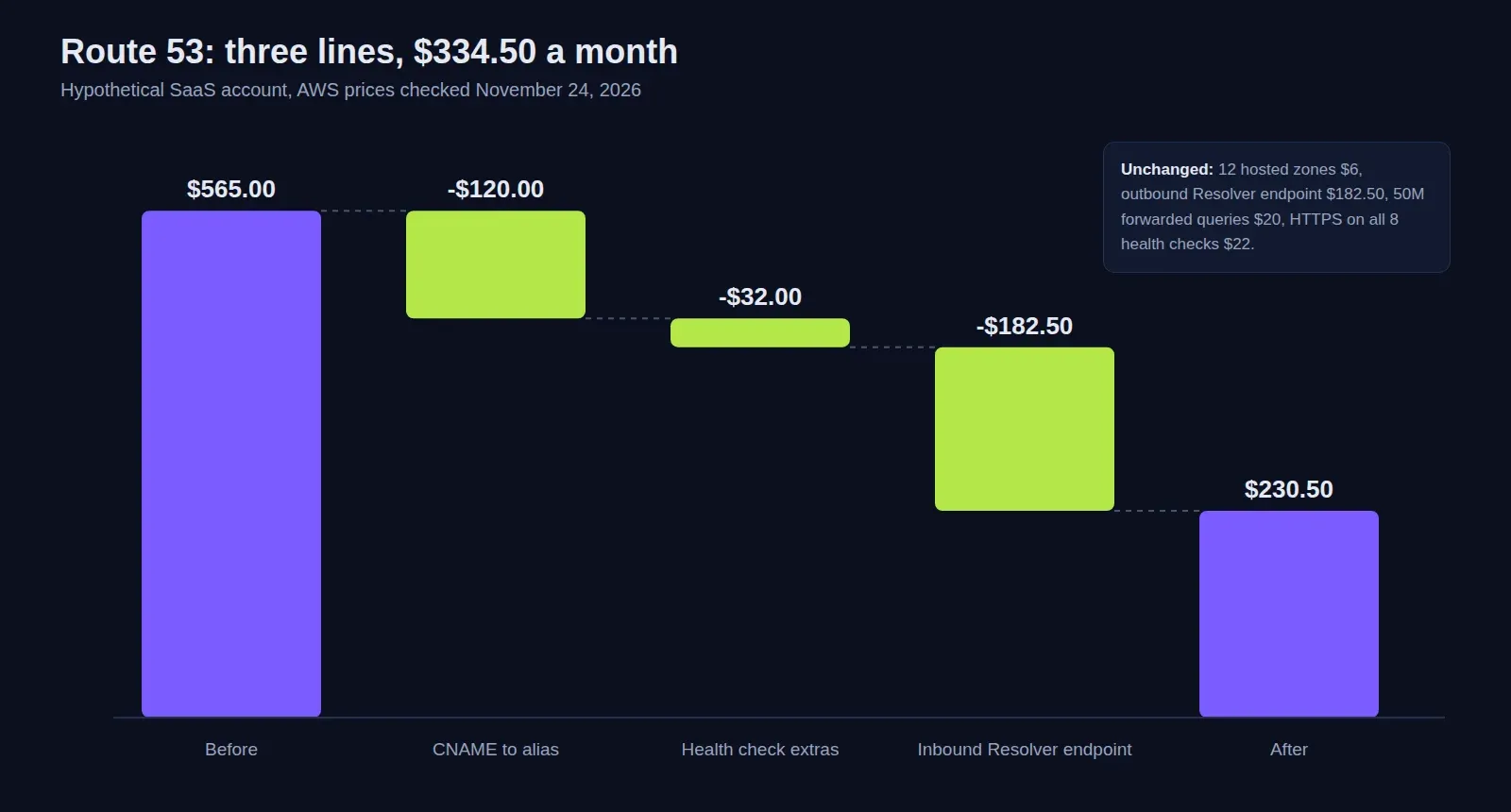
A hypothetical SaaS company with 12 hosted zones, 300 million standard queries a month on CNAMEs to its load balancers, 8 health checks on endpoints outside AWS with three features each, and an inbound plus an outbound Resolver endpoint (two interfaces each) forwarding 50 million queries:
- Hosted zones: 12 x $0.50 = $6.00
- Standard queries: 300 x $0.40 = $120.00
- Health checks: 8 x ($0.75 + 3 x $2) = $54.00
- Resolver endpoints: 4 interfaces x 730 hours x $0.125 = $365.00
- Resolver queries: 50 x $0.40 = $20.00
That’s $565.00 a month. Switch the CNAMEs to alias records ($0), keep only HTTPS on the health checks (8 x $2.75 = $22), and remove the inbound endpoint once nobody in the office needs to resolve VPC names ($182.50). The bill becomes $230.50, about $4,000 a year less, with no change users can see.
You can run your own numbers in the Route 53 pricing calculator. If you want to know which records still answer as CNAMEs, aws route53 list-resource-record-sets --hosted-zone-id <id> lists them with their type and TTL, and Cost Explorer grouped by usage type shows which Route 53 line is the big one.
Route 53 is rarely the biggest line on an AWS bill, and when it’s big it tends to sit next to other forgotten things: an idle NAT gateway, an old load balancer. Our idle AWS costs list covers those. If you’d rather someone read the whole bill, the free cloud cost audit is $0 and needs only the bill lines, and we reduce startup AWS bills for $0 up front, paid from 50% of the verified monthly saving for 6 months, nothing if nothing is saved.
Want us to look at your bill?
No upfront fee: for six months you pay half of what we save you each month, then you keep all of it. Nothing saved, nothing owed.
Also here: Free cloud cost audit ($0) · Cloud cost optimization services: $0 up front · Reduce your startup's AWS bill · FinOps for startups: $0 audit · Pricing: paid only from verified savings · Move from AWS to a European cloud