
twilio · sms · pricing
Twilio SMS Pricing: One Emoji Can Triple the Bill
By Aakash Verma ·
Twilio SMS pricing in the US is $0.0083 per segment, sent or received, on a long code, a toll-free number or a short code. On top of that, the receiving carrier adds its own fee to every outbound segment: $0.0035 for AT&T, $0.0045 for T-Mobile, $0.005 for Verizon. So a text costs about $0.012 to $0.013 before anything else, and the word that matters in that sentence is segment.
Every number here is from Twilio’s US SMS pricing page, which says “Pricing current as of November 2026”, checked on November 15, 2026. The Twilio SMS pricing calculator runs the same maths on your own volume.
A message is not a segment
A plain SMS holds 160 characters. Go over and it splits, and each part holds 153, because a few characters per part go to the header that stitches them back together on the phone. Twilio bills every part. Its own segment explainer goes through the details.
That’s the GSM-7 alphabet: letters, digits, common punctuation, straight quotes. The moment a message contains one character outside it, the whole text is sent as UCS-2, and the limits fall to 70 characters for a single segment and 67 per part.
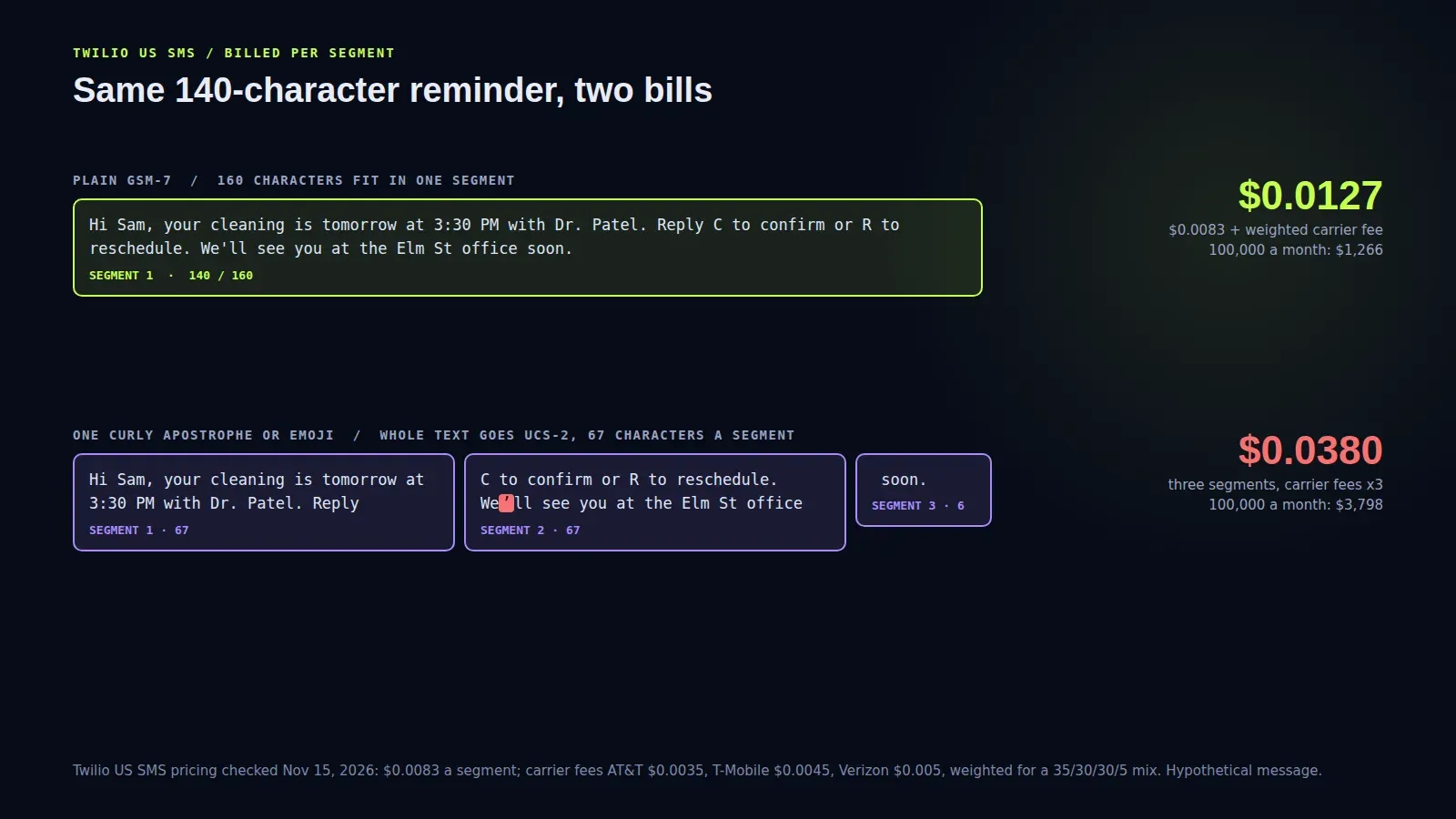
The characters that do it are rarely deliberate. An emoji in a marketing template, sure. But also a curly apostrophe that a CMS or a copy-paste from Google Docs put in “you’re”, an em dash, an accented name pulled from your user table. A 140-character reminder that says “we’ll” with a curly apostrophe is three segments; the same text with a straight one is one.
What a month of texts costs
A hypothetical app: 100,000 reminders a month to US users from one long code, each 140 characters. Its users are 35% Verizon, 30% T-Mobile, 30% AT&T and 5% on smaller networks (those pay $0.0042). Around 5,000 people reply, and about 2,000 sends end up “Failed” (bad numbers, landlines).
| Line | Plain text (1 segment) | One emoji (3 segments) |
|---|---|---|
| Outbound segments | 100,000 | 300,000 |
| Twilio, $0.0083 a segment | $830.00 | $2,490.00 |
| Carrier fees (weighted $0.00436 a segment) | $436.00 | $1,308.00 |
| 5,000 inbound replies, $0.0083 + carrier | $50.50 | $50.50 |
| Failed message fee, $0.001 each | $2.00 | $2.00 |
| Long code number | $1.15 | $1.15 |
| 10DLC campaign fee | $10.00 | $10.00 |
| Month | $1,329.65 | $3,861.65 |
Same users, same reminders, $2,532 a month apart. That’s over $30,000 a year for a smiley face.
Two things in that table are easy to miss. The carrier fees are more than half of Twilio’s own price, and they’re per segment too, so they triple with everything else. And inbound isn’t free: every reply costs the $0.0083 base, plus $0.0035 from AT&T users and $0.0025 from T-Mobile users.
The fixed costs are small, until they aren’t
A long code is $1.15 a month and a toll-free number $2.15. Sending application-to-person texts from a long code means A2P 10DLC registration: a one-time brand fee ($4 for low-volume or sole proprietor brands, $44 for standard ones that send over 6,000 segments a day), $15 per campaign for vetting, and $1.50 to $10 a month per campaign. Annoying paperwork, cheap money.
Short codes are a different league: $1,000 a month for a random one, $1,500 for a vanity number, billed quarterly with a setup fee on top. Worth it for very high volume or throughput, not for an app sending a few hundred thousand texts.
Then the small add-ons. The Engagement Suite (link shortening, click tracking, scheduling) is $0.015 per outbound SMS after the first 1,000 a month. That is more than the message itself. If all you need is a short link, your own redirect on your own domain costs nothing per click.
Verify costs four times the text
If the texts are login codes, check whether you’re on Programmable SMS or Twilio Verify. Verify charges $0.05 per successful verification plus $0.0083 per SMS it sends. For 10,000 logins a month that’s $583, against roughly $127 for sending your own codes at the rates above. Verify isn’t overpriced for what it does: it generates and checks the codes, rate-limits, and includes its Fraud Guard against SMS pumping, where bots trigger codes to premium numbers. Rolling your own means building those parts or eating the fraud. But a lot of apps are on Verify because a tutorial used it, not because anyone compared.
Supabase phone sign-in supports both Twilio and Twilio Verify as providers (Supabase phone login docs), so this choice is usually one setting in the auth dashboard. The auth vendors bill SMS codes separately too: our Clerk pricing post covers its $0.01 SMS line.
Where we’d look first on a Twilio bill
Open the Messaging logs, export a week, and compare the segment count to the message count. If the ratio is above 1.1 for transactional texts, something in your templates is either too long or not GSM-7. Then:
- Strip curly quotes, em dashes and emoji from transactional templates. Replace them in code before sending, not by hand.
- Trim reminders to 160 characters. “Your appointment with Dr. Patel is tomorrow at 3:30 PM” doesn’t need the clinic’s full address and a link.
- Stop texting numbers that keep failing. Each failure is only $0.001, but it usually means a dead list.
- Move anything that isn’t time-critical to push or email.
If texts are one line among several usage-billed tools, that’s what our cloud cost optimization service is for: $0 up front, then 50% of the verified monthly saving for 6 months, nothing if nothing is saved. Or send the bill for a free cloud cost audit, which costs $0 and reads every line.
Want us to look at your bill?
No upfront fee: for six months you pay half of what we save you each month, then you keep all of it. Nothing saved, nothing owed.
Also here: Free cloud cost audit ($0) · Cloud cost optimization services: $0 up front · Reduce your startup's AWS bill · FinOps for startups: $0 audit · Pricing: paid only from verified savings · Move from AWS to a European cloud