
cloud run · google cloud · pricing
Cloud Run Pricing: When Instance Billing Beats Per-Request
By Aakash Verma ·
Google Cloud Run pricing comes in two billing modes, and most teams never look at which one their service is on. The default, request-based billing, charges $0.000024 per vCPU-second and $0.0000025 per GiB-second only while an instance is handling requests, plus $0.40 per million requests. Instance-based billing charges $0.000018 per vCPU-second and $0.000002 per GiB-second for the whole time an instance is up, and no request fee. Those are the us-central1 prices on Google’s Cloud Run pricing page, checked on November 17, 2026.
So instance-based is 25% cheaper per second and bills more seconds. Which one wins depends on how busy your instances are, and the request fee moves that line more than people expect.
The free tier, per billing account
Each month Google gives away, on request-based billing, 180,000 vCPU-seconds, 360,000 GiB-seconds and 2 million requests. On instance-based billing it’s 240,000 vCPU-seconds and 450,000 GiB-seconds. The free tier is per billing account, not per project, so ten small services share one allowance. Billed time is rounded up to the nearest 100 milliseconds.
That free tier is why a hobby API on Cloud Run often costs nothing. 180,000 vCPU-seconds is 50 hours of one busy vCPU a month.
Three hypothetical services
All three use 1 vCPU and 1 GiB of memory in us-central1, with a 730-hour month (the month Google’s own calculator uses). Busy time is requests times average duration, divided by how many requests an instance handles at once.
An API with 10 million requests a month, 300 ms each, about 10 in flight per instance. That’s 300,000 busy instance-seconds. Request-based: CPU (300,000 minus the 180,000 free) x $0.000024 = $2.88, memory stays inside the free 360,000, requests (10 million minus 2 million free) x $0.40 per million = $3.20. Total $6.08 a month. On instance-based billing the same traffic, spread over the day, keeps one instance up all month: 2,628,000 seconds, which is $42.98 of CPU and $4.36 of memory after the free tier. $47.34. Request-based wins by a mile, because the instance is busy about 11% of the time.
The same API with one minimum instance, so the first request of the morning doesn’t wait for a cold start. Idle minimum instances bill at $0.0000025 per vCPU-second and the same per GiB-second. The 2,328,000 idle seconds add $11.64, so $17.72 a month. Fine, if you meant to. We regularly see three or four minimum instances on services that get a request a minute, set during a launch and never touched again.
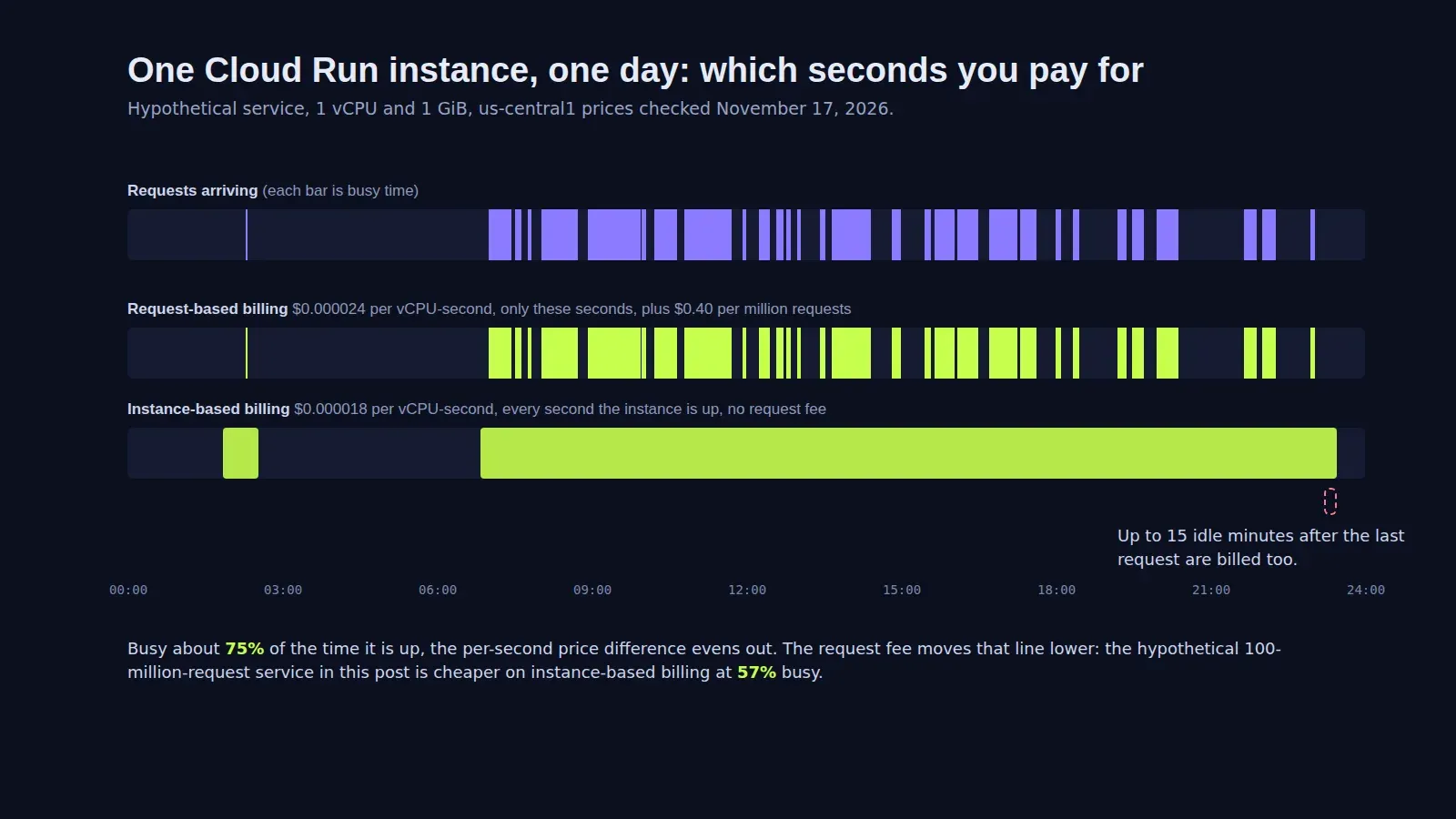
A busier service: 100 million requests a month, same 300 ms, same concurrency. Now it’s 3,000,000 busy seconds, which needs at least two instances up. Request-based: $67.68 CPU, $6.60 memory, $39.20 in request fees, $113.48. Instance-based with two instances up all month: $90.29 CPU, $9.61 memory, $99.90. Instance-based wins even though the instances are only about 57% busy, because it skips $39.20 of request fees.
The rule of thumb
On CPU alone, instance-based billing breaks even when instances are busy about 75% of the time they’re up ($0.000018 is three quarters of $0.000024). Short, frequent requests pull that down, because each one adds to the $0.40-per-million fee that instance-based billing doesn’t charge. Google’s billing settings docs put it more vaguely: instance-based is “recommended when incoming traffic is steady, slowly varying.”
Two things to know before you switch. Instance-based billing charges for idle time, and the docs say an instance can stay idle for up to 15 minutes after its last request, so spiky traffic with long gaps gets more expensive, not less. And it’s the setting that also keeps the CPU running outside requests, which background work started after a response needs anyway. The switch is one flag: gcloud run services update SERVICE --no-cpu-throttling (and --cpu-throttling to go back).
Concurrency is the cheaper fix
Before touching billing modes, look at concurrency. Cloud Run lets one instance handle many requests at once, and on request-based billing overlapping requests share the billed instance time. The same 10 million requests at concurrency 1 instead of 10 make 3,000,000 busy seconds instead of 300,000: $77.48 a month instead of $6.08. Some frameworks and some old “one request per worker” setups force concurrency down to 1 without anyone deciding it. It’s also worth checking what the 300 ms is: if most of it is waiting on a database or an external API, you pay for CPU that’s doing nothing.
Committed use discounts exist too (a 1-year Cloud Run commitment brings request-based CPU to $0.00001992), but they only make sense for a baseline you’re sure you’ll keep.
Our Cloud Run pricing calculator runs these numbers for your traffic on both modes at once. Egress isn’t in it: Cloud Run gives 1 GiB a month free within North America, then bills at Google Cloud’s network pricing.
When Cloud Run is one line among Cloud SQL, load balancers, logging and egress, it’s easier to read the whole bill. Our free cloud cost audit costs $0 and looks at every line. If there’s real money to save, our cloud cost optimization service costs $0 up front and then 50% of the verified monthly saving for 6 months, nothing if nothing is saved. Comparing with AWS? The Fargate pricing post has the same “you pay for the size, not the load” problem from the other side.
Want us to look at your bill?
No upfront fee: for six months you pay half of what we save you each month, then you keep all of it. Nothing saved, nothing owed.
Also here: Free cloud cost audit ($0) · Cloud cost optimization services: $0 up front · Reduce your startup's AWS bill · FinOps for startups: $0 audit · Pricing: paid only from verified savings · Move from AWS to a European cloud