
free hosting · vercel · netlify
Free Hosting: The Real Limits of Vercel, Netlify, Cloudflare
By Aakash Verma ·
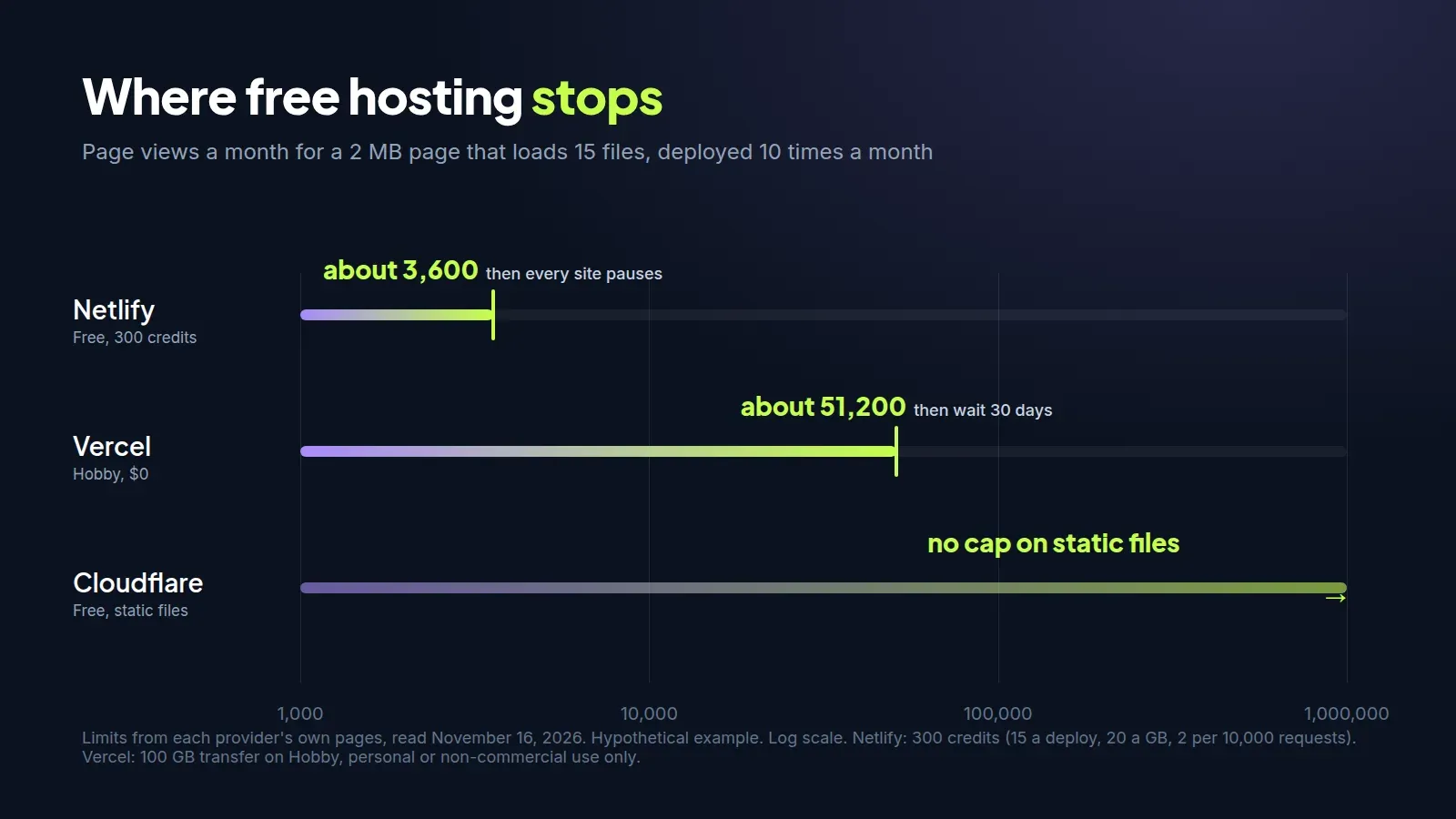
You can host a website for free on Vercel, Netlify, Cloudflare and Supabase, but each free tier runs out of something different, and the first one to run out is rarely the one people expect. Take a hypothetical 2 MB page that loads 15 files, deployed 10 times a month: Netlify’s free plan stops at about 3,600 page views a month, Vercel’s Hobby plan at about 51,000, and Cloudflare serves the static files with no cap at all.
Everything below comes from each provider’s own pages, read on November 16, 2026: Vercel’s Hobby plan docs, Netlify’s “How credits work”, Cloudflare’s Workers pricing and Pages limits, and Supabase’s pricing page. The free hosting limits calculator runs the same sums on your own numbers.
Netlify Free: 300 credits, and deploys spend them too
Netlify moved new accounts to credits in September 2025. The Free plan gets 300 credits a month as a hard limit, and the rates are the same on every plan: 15 credits per production deploy, 20 credits per GB of bandwidth, 2 credits per 10,000 web requests, 10 credits per GB-hour of function compute. Deploy previews and branch deploys cost nothing.
That makes the deploy line the surprise. Thirty production deploys a month is 450 credits, so a site that ships to main once a day is out of free credits before anyone visits it. In our 2 MB example, 10 deploys take 150 credits and every thousand page views takes about 42 more (40 from bandwidth, 2 from the 15,000 requests), which is where the 3,600 comes from.
When the credits hit zero, Netlify does not bill you. It pauses every site on the account, and visitors get a “Site not available” page until the month resets. Personal is $9 a month for 1,000 credits; Pro is $20 for 3,000. We broke the credits down further in Netlify pricing: what the credits actually pay for.
Vercel Hobby: generous on traffic, but not for a business
Hobby includes 100 GB of Fast Data Transfer, 1 million edge requests, 1 million function invocations, 4 CPU-hours of active CPU, 5,000 image transformations and 100 deploys a day. Go over one and the docs say you usually wait 30 days before that feature works again. There is no bill to run up, which is the good part.
The part people skip is the terms. Vercel’s terms of service say a Hobby plan is only for “personal or non-commercial use”. A product with paying users, ads or sales belongs on Pro, $20 a month per seat with 1 TB of transfer included and $0.15 per GB after that. A team of three on Pro is $60 before any traffic. If that sounds like a lot next to Netlify, we compared the two at five traffic levels in Netlify vs Vercel pricing; seats decide it on Vercel, bandwidth on Netlify.
Cloudflare: static files are free, the daily cap is on Workers
Cloudflare’s Workers pricing page says requests to static assets are free and unlimited. That is why the static version of our example never touches a limit there. The Pages free plan does limit builds (500 a month, one at a time), files (20,000 per site) and file size (25 MiB).
The limit that bites is on dynamic code. The free Workers plan allows 100,000 requests a day with 10 ms of CPU per request. It is a daily cap, so an API that averages 60,000 calls a day can still fail on a launch day with 140,000. Past the cap, requests fail until the next day. Workers Paid is $5 a month with 10 million requests included, then $0.30 a million, and it has no daily cap. Of the four, this is the cheapest paid step by a distance.
Supabase Free: the database pauses when nobody uses it
Supabase Free covers 50,000 monthly active users, a 500 MB database, 5 GB of egress, 5 GB of cached egress and 1 GB of file storage, with 2 active projects. The number that catches people is not on that list as a quota: a free project is paused after a week with no activity. Fine for a demo, bad for a product whose first customer signs up on a Sunday.
Pro is $25 a month per organization and includes the first project: 100,000 MAU, 8 GB of disk, 250 GB of egress and 100 GB of storage. Our Supabase pricing calculator and the post on why Supabase bills get high pick up from there.
Which one to start on
For a static marketing site, Cloudflare. Nothing in the free plan grows with traffic.
For a Next.js app you are still validating, Vercel Hobby is the most comfortable free tier, as long as nobody is paying you yet. On the day you charge your first customer, Vercel’s terms move you to Pro, so plan for $20 a seat from then on.
Netlify Free is the one to watch. It is fine for a personal site deployed a few times a month and tight for anything with images and daily deploys, and the failure mode (every site on the account paused) is the harshest of the four.
Supabase Free sits behind any of them as the database. It is enough for a launch, except for the pause, so upgrade before you have users who could notice it.
The free tiers are honest about their limits. The harder bill comes later, when the app makes money and runs on three or four of these at once. If that bill has started to grow faster than your revenue, our cloud cost optimization service costs $0 up front and is paid as 50% of the verified monthly saving for 6 months, nothing if we save nothing, and the free cloud cost audit is $0: send the main lines of the bill and a person tells you which ones are too big.
Want us to look at your bill?
No upfront fee: for six months you pay half of what we save you each month, then you keep all of it. Nothing saved, nothing owed.
Also here: Free cloud cost audit ($0) · Cloud cost optimization services: $0 up front · Reduce your startup's AWS bill · FinOps for startups: $0 audit · Pricing: paid only from verified savings · Move from AWS to a European cloud